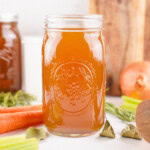
Homemade vegetable stock
This homemade vegetable stock uses whole vegetables, fresh herbs, and a slow simmer to create a deeply flavorful base for soups, stews, and countless recipes.
Servings: 96 ounces
Calories: 3kcal
Ingredients
- 1 Gallon Water
- 1 Head Celery
- 2 Medium Yellow Onions
- 5 Medium Carrots
- 1 Head Garlic
- 12 Sprigs Thyme
- 4 Sprigs Rosemary
- 3 Sprigs Sage
- 5 Bay Leaves
- 2 Tablespoons Whole Peppercorns
- 1 Teaspoon Salt optional
Instructions
- Start by washing all your vegetables thoroughly to remove any dirt or debris. Cut the celery head into 3-inch pieces from the roots to the leaves, then add them to your large stock pot. Quarter the carrots and onions—leave all roots and skin on the carrots, but remove just the onion roots. Add these vegetables to the pot along with your prepared celery.
- Slice the head of garlic in half width-wise so all the cloves are exposed, then add both halves to the stock pot without peeling. Add all the fresh herbs—thyme, rosemary, and sage—along with the bay leaves and whole peppercorns to the pot. If you're adding salt, include it now, though leaving it out gives you more flexibility when using the stock later.
- Pour the entire gallon of water over the vegetables and herbs in the pot. Bring the mixture to a boil over high heat, then reduce to low or medium-low and let it simmer for 1 hour. The slow simmer extracts all the wonderful flavors from the vegetables without making the stock cloudy.
- After an hour of simmering, remove the large vegetable pieces with tongs or a slotted spoon before straining. Set up a mesh strainer over a large bowl or another pot, then carefully pour the remaining stock through to catch any small bits. This double-straining process ensures a clear, beautiful stock.
- Carefully fill your mason jars with the hot stock and seal them with lids immediately while the liquid is still hot. Let the jars rest on the counter for about 2 hours until they reach room temperature. Once cooled, retighten the lids and store them in the refrigerator.
Notes
- Use vegetable scraps - Save vegetable scraps like onion peels, carrot tops, celery leaves, and herb stems in a freezer bag. When you have enough scraps, make a batch of stock to reduce waste and save money.
- Don't skip the resting time - Letting the hot stock cool completely before refrigerating prevents condensation and helps the jars seal properly. This step is crucial for the 2-month storage life.
- Avoid bitter vegetables - Skip cruciferous vegetables like broccoli, cabbage, and Brussels sprouts as they can make your stock taste bitter and overpowering during the long simmer.
- Size matters - Cutting vegetables into larger pieces (3 inches) prevents them from breaking down too much and making the stock cloudy. Larger pieces also make straining easier.
- Taste before storing - Once your stock is done, taste it to check the seasoning. If you didn't add salt during cooking, you can add it now if you know what you'll be using the stock for.
Nutrition
Calories: 3kcal | Carbohydrates: 1g | Protein: 0.1g | Fat: 0.02g | Saturated Fat: 0.01g | Polyunsaturated Fat: 0.01g | Monounsaturated Fat: 0.003g | Sodium: 29mg | Potassium: 18mg | Fiber: 0.2g | Sugar: 0.3g | Vitamin A: 540IU | Vitamin C: 1mg | Calcium: 5mg | Iron: 0.1mg